BTC ETH Daily Recap — May 27, 2026

BTC ETH Daily Recap — May 27, 2026
Today at a Glance
The crypto market opened the week with a cautious tone, as Bitcoin and Ethereum both recorded modest losses over the past 24 hours. Bitcoin slipped 0.94% to $75,219, trading within a narrow range between $74,866 and $76,174. The asset remains under pressure on the weekly timeframe, down 3.01%, with the 7-day moving average at $76,492 acting as immediate overhead resistance. Ethereum showed relative resilience in the short term, declining only 0.19% to $2,070, but its 30-day performance reveals deeper weakness at -9.59%. The RSI for both assets sits in or near oversold territory—BTC at 34.0 and ETH at 27.1—suggesting bearish momentum is prevailing. Volume for both coins is notably below their respective 7-day averages (BTC at 0.77x, ETH at 0.54x), indicating reduced trader participation and a lack of conviction in current price levels. The market appears to be in a consolidation phase, with sellers maintaining control near key moving averages.
Bitcoin Analysis
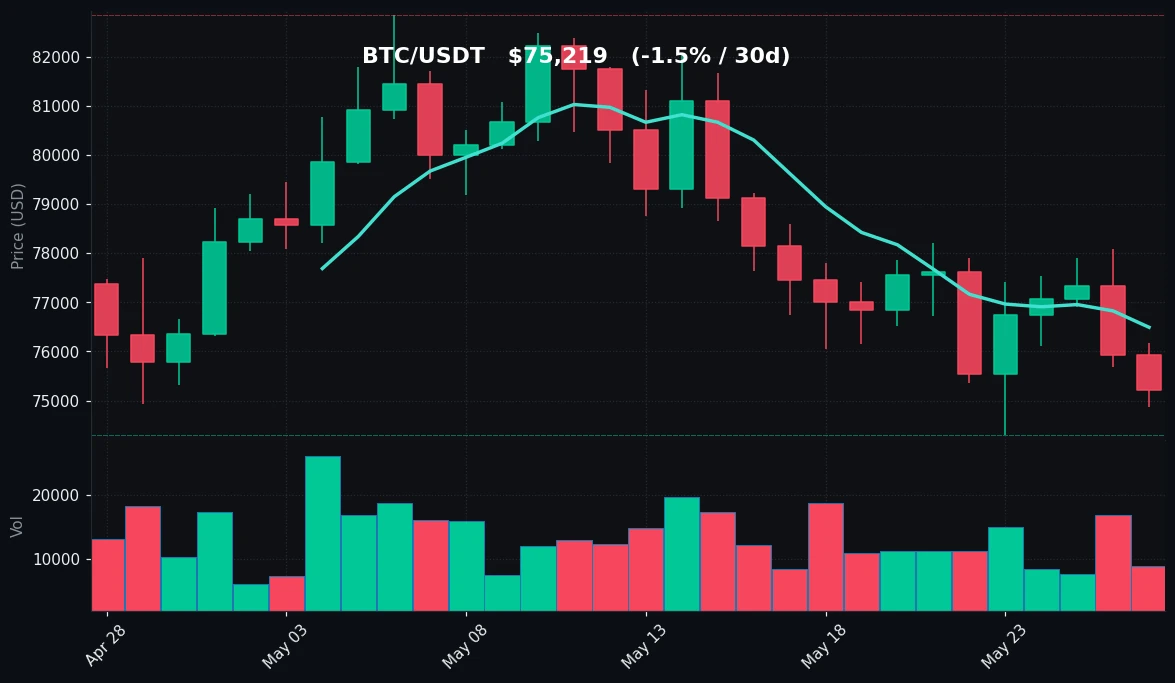
TradingView Live (4h)
Bitcoin’s price action on May 27 reflects continued selling pressure following a week of declines. The asset opened near $75,900 and drifted lower through the session, touching an intraday low of $74,866 before recovering slightly to close at $75,219. This marks the second consecutive daily decline and places BTC near the lower end of its 7-day range ($74,290–$78,200). The 30-day range is wider, with a high of $82,850 and a low of $74,290, indicating that the current price is closer to the monthly floor than the ceiling.
From a technical perspective, Bitcoin is trading below both the 7-day moving average ($76,492) and the 30-day moving average ($78,449). The MA7 has been declining since mid-May, and the spread between the two averages is widening, a classic bearish signal. The RSI at 34.0 is in oversold territory but not yet at extreme levels, suggesting that while selling momentum is strong, a reversal is not imminent. Volume is significantly below the 7-day average at 0.77x, which implies that the current move lacks strong participation—potentially a sign of exhaustion rather than aggressive distribution.
Key support is being tested around $74,290, the 30-day low. A break below this level could open the door to further downside toward $73,000 or lower. Resistance is clear at $76,492 (MA7) and $78,449 (MA30). Until Bitcoin can reclaim the MA7, the trend remains bearish in the short term. The lack of volume suggests that traders are waiting for a catalyst, and the market may be in a holding pattern ahead of macroeconomic data later in the week.
Ethereum Analysis
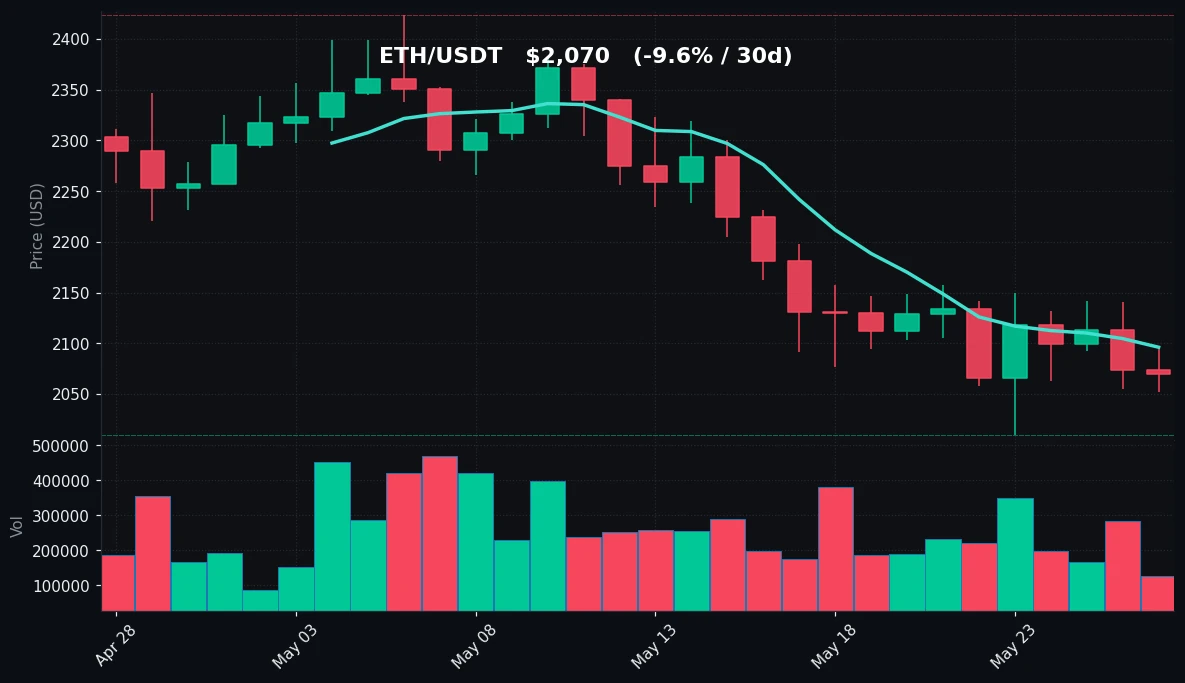
TradingView Live (4h)
Ethereum’s price action on May 27 was relatively subdued compared to Bitcoin, with a 24-hour decline of just 0.19% to $2,070. The asset traded in a tight range between $2,052 and $2,097, reflecting a lack of directional bias. However, the broader picture is more concerning: ETH has lost 2.80% over the past week and 9.59% over the past 30 days, underperforming Bitcoin in both timeframes.
Technically, Ethereum is trading well below both its 7-day moving average ($2,096) and its 30-day moving average ($2,228). The MA7 has been sloping downward since early May, and the gap between the two averages is substantial, indicating sustained bearish momentum. The RSI at 27.1 is in deeply oversold territory—lower than Bitcoin’s reading—suggesting that ETH may be due for a technical bounce, but the trend remains firmly bearish. Volume is extremely low at 0.54x the 7-day average, signaling that most traders are on the sidelines.
Support is currently being tested around $2,009, the 30-day low. A break below this level would mark a new monthly low and could accelerate selling toward $1,950 or lower. Resistance is at $2,096 (MA7) and $2,228 (MA30). The oversold RSI reading could attract short-term buyers, but without volume confirmation, any bounce is likely to be shallow. Ethereum’s relative weakness compared to Bitcoin suggests that capital is rotating out of altcoins and into the market leader during this risk-off period.
Key Technical Levels
| Asset | Support | Resistance | RSI |
|---|---|---|---|
| BTC | $74,290 | $76,492 | oversold (34.0) |
| ETH | $2,009 | $2,096 | oversold (27.1) |
BTC vs ETH Dynamic
The correlation between Bitcoin and Ethereum remains high, but Ethereum is showing signs of relative weakness. Over the past 30 days, BTC has declined 1.47%, while ETH has dropped 9.59%, a performance gap of over 8 percentage points. This divergence suggests that selling pressure is more concentrated in ETH, possibly due to lower liquidity or higher sensitivity to macroeconomic headwinds. In the short term, ETH’s RSI is more oversold than BTC’s, which could lead to a catch-up rally if sentiment improves. However, the volume deficit in both assets indicates that traders are not yet ready to commit to a directional move. The ETH/BTC ratio has been declining, currently near 0.0275, reflecting the market’s preference for Bitcoin as a store of value during uncertainty.
Strategy Fit
Given the current low-volatility, low-volume environment, trend-following strategies are not ideal. Both BTC and ETH are trading below key moving averages with oversold RSI readings, suggesting that the market is in a consolidation phase rather than a clear downtrend. Grid trading strategies are well-suited for this type of market, as they profit from range-bound price action without requiring directional conviction. For BTC, a grid between $74,000 and $77,000 can capture the current range. For ETH, a grid between $2,000 and $2,150 is appropriate. Dollar-cost averaging (DCA) into both assets is also viable for long-term accumulators, given the oversold conditions, but should be done with caution as the trend remains bearish. Pionex’s built-in grid trading bots are ideal for this environment, allowing users to automate buy-low-sell-high orders within a defined range without needing to monitor the market constantly. Trend-following bots should be avoided until a clear breakout above MA7 or below support is confirmed.
Risk Disclaimer
This market recap is for informational and educational purposes only and does not constitute financial advice, investment recommendation, or solicitation to buy or sell any cryptocurrency. Cryptocurrency markets are highly volatile and involve substantial risk of loss. Past performance is not indicative of future results. You should consult with a qualified financial advisor before making any investment decisions. The author and Pionex are not responsible for any trading losses incurred based on this content.
FAQ
What is the current RSI for Bitcoin and Ethereum?
Bitcoin’s RSI(14) is 34.0, which is in oversold territory. Ethereum’s RSI(14) is 27.1, also oversold and deeper than BTC.
Why is volume lower than average for both BTC and ETH?
Volume for BTC is at 0.77x the 7-day average, and for ETH at 0.54x. This indicates reduced trader participation, often seen during consolidation phases or ahead of major news events.
What are the key support levels to watch?
For Bitcoin, the key support is $74,290 (30-day low). For Ethereum, support is at $2,009 (30-day low). A break below these levels could signal further downside.
Is this a good time to buy the dip?
The oversold RSI readings suggest potential for a bounce, but the trend remains bearish with both assets below key moving averages. Dollar-cost averaging or grid trading may be more appropriate than a lump-sum buy.
How does Ethereum’s performance compare to Bitcoin?
Ethereum has underperformed Bitcoin significantly over the past 30 days (-9.59% vs -1.47%), indicating capital rotation toward BTC during risk-off sentiment.


